DEBORAH A. ANDERSON
  • Home
  • 100 Black
  • Speaking
  • Consultant
  • About
  • Blog
  • Contact

Toastmasters Speech #5 - "The 12 Principles of Animation"

7/29/2016

0 Comments

 
Picture
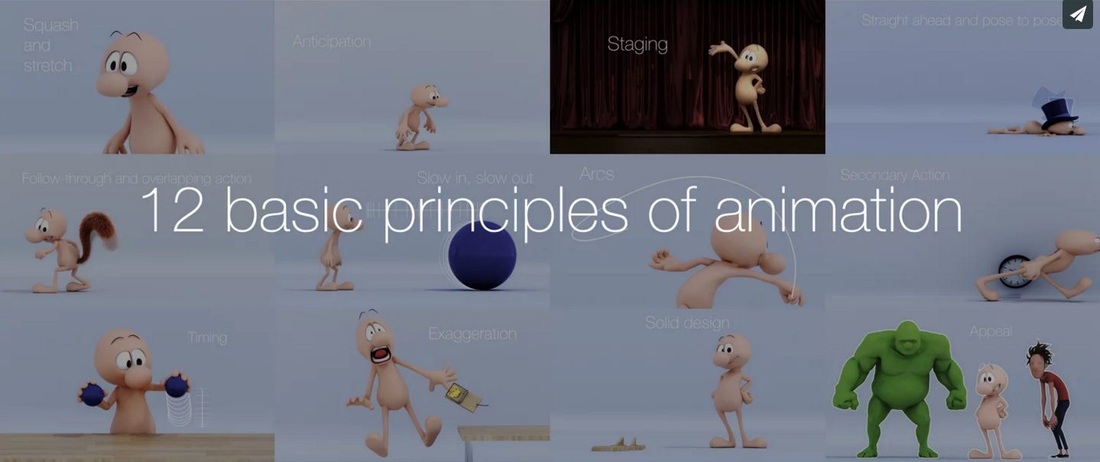
This speech was an overview of the 12 Principles of Animation. In that it was a 5-7 minute speech, I knew it was too much content, but giving this particular speech was more for personal evaluation than the evaluation of the club. I had just done a workshop for the Boy Scouts on these same principles and I realized that I spent too much time explaining them, so I wanted to see how quickly I could go over the principles. This will help me in future workshops.

Disney animators used the 12 principles of animation to create some of our favorite movies. Disney’s core animators, who worked on Snow White and the Seven Dwarfs and other movies, were nicknamed the “Nine Old Men”. Two of those animators wrote a book, “The Illusion of Life: Disney Animation”, that introduced the 12 principles of animation to the world. I would like to let you look behind the curtain and tell you about these tenets.

Squash and Stretch

  • The most popular principle that a lot of people recognize. It helps show the weight and flexibility of objects. You’ll mostly see people introduce this concept using a bouncing ball. To keep squash and stretch realistic, the volume has to stay consistent.
    • Balloon vs. bowling ball
    • Person chewing
    • Video game jump

Anticipation

  • Used to prepare the audience for an action. It heightens the suspense
    • Preparing to run
    • Golfer swing
    • Looking off-screen, preparing for someone’s arrival
    • Picking up a heavy object

Staging

  • Directs the audience’s attention and makes it clear what is most important in the scene
  • Placement, light/shadow, angle/position of camera
  • No competing
    • Flashlight, scary story
    • Brighter colors
    • Camera looking up at an intimidating boss
    • One action finishes before another one starts
      • A person shouldn’t walk on screen during a monologue

Straight Ahead/Pose to Pose

  • Straight Ahead – animating frame by frame from beginning to end
    • Fluid/dynamic movement – action sequences
    • Fire, water, smoke
  • Pose to Pose – keyframes and filling in later
    • Dramatic/emotional scenes
    • Bunny w/ floppy ears
    • Dancer spin

Follow Through/Overlapping Action

  • Follow Through – An object in motion stays in motion
  • Connected parts keep moving after the main object stops
    • Ears, antenna, hair
  • Overlapping Action – different parts move at different speeds
    • Dog’s legs vs. dog’s tail

Ease In/Ease Out

  • Objects need time to accelerate and slow down
    • Illustrate using arm as windshield wiper
    • Exaggerate dance move (waltz – Beauty/Beast)

Arcs

  • Natural action follows arcs
  • Mechanical objects move in straight lines
  • Higher speed -> flatter arcs (Fastball vs. floater)
  • Ball doesn’t bounce in “V” formation, it bounces in arcs
  • Throwing Frisbee

Secondary Action

  • Gives more life and dimension to the main action
    • Mickey Mouse whistle
  • Emphasizes rather than takes away
  • Beginning or end of the action
    • Fight scene, no facial expressions away from camera
    • Person crying, falling tear, tissue

Timing

  • Time taken for a particular action
    • Regular walking vs. exaggerated
    • Regular crying vs. large eyes, quivering lip, burst out

Exaggeration

  • Keeps animation from being dull
  • Level of exaggeration depends on realism or style
  • Supernatural/fantasy (superpowers/fairies)
    • Superman pose vs. puffed out chest
    • Spongebob’s “How to blow a bubble”
    • Eyes coming out of socket (surprise)

Solid Drawing

  • 2D is about keeping volume and weight
    • Flat drawing
    • Floating bouncing ball or walking feet
    • Spheres, cubs, cylinders vs. circles, squares, rectangles
    • Spinning square vs. cube
  • 3D posing, silhouette, stay away from twinning
    • Symmetrical two hand on hip pose vs. one hand on hip

Appeal

  • Charisma/Personality
  • Heroes and villains
    • Hercules
    • Jafar
  • Fascinating/attention grabbing
    • Witch-hunched over
    • Girl – small & cute
    • Bully – big and mean

So those are the 12 principles of animation. If you plan on watching an animated movie anytime soon, maybe you’ll notice a couple. Hopefully, I haven’t ruined movies for you forever like it is for people with film degrees.
0 Comments

Your comment will be posted after it is approved.


Leave a Reply.

    Deborah's Blog

    Updates about ongoing projects and interesting 3D news.

    Archives

    October 2017
    July 2017
    June 2017
    May 2017
    April 2017
    March 2017
    July 2016
    June 2016
    May 2016
    April 2016
    March 2016
    January 2016
    December 2015
    October 2015
    July 2014

    Categories

    All
    3D Gumshoe
    Advice
    Animation
    Blender
    Career
    Cinema 4D
    Maya
    Projects
    South Korea
    Toastmasters
    Workshops

    RSS Feed

(C) 2025 All Rights Reserved. Deborah A. Anderson

  • Home
  • 100 Black
  • Speaking
  • Consultant
  • About
  • Blog
  • Contact